
Time management for solo entrepreneurs looks nothing like time management for someone with a team. No manager sets priorities, no colleague covers a busy week, and no one notices when the day quietly slips away. You are the strategist, the marketer, the support desk, and the bookkeeper, often before lunch.
That is why generic productivity advice so often fails. It assumes a structure you do not have. What works for a solo founder is simpler: a small set of habits that protect your attention, reduce repeat work, and ensure the tasks that grow the business get done first.
This guide covers eleven of those habits, grouped into four areas: planning, focus, boundaries, and systems. Each one is practical enough to start this week. And because many of the biggest time drains in a one-person business come from scattered tools, we will also show where a single platform like Vonza can give hours back.
Why Time Management for Solo Entrepreneurs Is Different
When you work alone, every decision lands on you, and decisions are expensive. Deciding what to do next, over and over, is tiring in itself, and it is one reason a full day can end with little to show for it.
Three pressures shape a solo founder’s day:
- Context switching: jumping between sales, delivery, and admin leaves no room to settle into any of them.
- The absence of outside deadlines makes it easy for important but non-urgent work to wait indefinitely.
- The habit of treating busyness as progress.
Solving these is the real work of time management for solo entrepreneurs, and it has less to do with fitting more into the day than with deciding which tasks deserve your best hours.
A helpful way to see your own day is to sort your work into three kinds. Revenue work is anything that brings in or keeps customers, such as outreach, follow-ups, and sales conversations. Delivery work is producing what you sold. Admin is everything else. Most solo founders spend the majority of their time on delivery and admin, and only a little on revenue work. The tips below are designed to shift that balance.
The cost of getting this wrong is rarely dramatic, which is why it goes unnoticed. A follow-up that waits a week turns a warm lead cold. An invoice sent late is paid late. A launch slips because the week was spent on small requests. Over a quarter, these small delays add up to lost revenue and a steady feeling of being behind, and for many solo founders that feeling is the first step toward burnout. Treating your time as a limited business resource, in the same way you treat money, changes how you make everyday choices.
Part 1: Plan Your Week Before It Plans You
Planning feels like a luxury when you are busy, but it is the cheapest way to recover time. A little structure at the start of the week prevents a lot of reactive scrambling later.
1. Hold a 30-minute weekly review
Choose a fixed time, such as Friday afternoon or Monday morning, and look at three things: what you finished, what slipped, and what must happen next week. Write down your top three outcomes for the coming week. The review does not need to be elaborate. Its value is that you start the week deciding, rather than reacting to whatever arrives first in your inbox.
To keep the review quick, use the same questions every time. What moved the business forward this week? What took longer than expected, and why? Which conversations or leads need attention? What is the one outcome that would make next week a success? Answering these in writing takes about ten minutes, and over a few months the notes become a useful record of what actually drives your results.
2. Choose three priorities for each day
Long to-do lists create a false sense of obligation and hide what matters. Each evening, pick three tasks that would make the day a success and put the most important one first. Anything beyond the three is a bonus. This limit forces honest trade-offs, and it gives you a clear signal about when the working day is done.
For example, a freelance designer’s three priorities for a Tuesday might be to send a proposal to a warm lead, finish the first draft of a client logo, and book two discovery calls. Notice that each item is specific and finishable. Work on marketing is not a priority, because you can never tell when it is done. If a task is too large to finish in a day, rewrite it as the next visible step.
3. Block your time
Instead of working from a list, assign tasks to specific blocks in your calendar. Reserve a recurring block for revenue work, another for delivery, and a short one for admin. If you track your leads and customers in a simple CRM, your revenue block starts with a ready list of people to follow up with, rather than a search through old emails. Time blocking also makes it obvious when you have promised more than a week can hold.
A simple structure many solo founders use is to keep mornings for focused delivery work, early afternoon for revenue work such as outreach and follow-ups, and late afternoon for admin and planning the next day. Add buffer blocks of fifteen to thirty minutes, because tasks almost always take longer than expected. A calendar with no breathing room tends to fail by Wednesday, and then the whole system gets abandoned.

Part 2: Protect Your Focus and Your Energy
A solo founder’s most limited resource is not time but uninterrupted attention. These habits protect it.
4. Guard your best two hours
Most people have a window each day when their thinking is sharpest. Find yours and use it for the work that needs the most concentration, such as writing an offer, planning a launch, or solving a client problem. Keep email, messages, and meetings out of that window. Routine tasks can wait for the lower-energy parts of the day.
If you are not sure when your sharpest hours are, run a short experiment. For one week, note your energy and concentration at three points in the day, then compare the results. Most people see a pattern within a few days. Once you know it, treat that window like a client appointment: it is booked, and other requests have to fit around it.
5. Batch similar tasks
Switching between different kinds of work carries a cost each time. Group similar tasks together and do them in one sitting: reply to emails twice a day, write a week of social posts in one session, and send all your invoices on the same afternoon. Batching shortens the time each task takes because you stay in one mode of thinking.
6. Reduce interruptions at the source
Turn off non-essential notifications, close tabs you do not need, and keep your phone out of reach during focus blocks. Few people can resist a notification that is already in front of them, so remove the temptation instead of relying on discipline. Even a short run of uninterrupted work tends to produce more than a long stretch of distracted effort.
It also helps to set fixed windows for checking messages. Looking at your inbox at set times, for example mid-morning and late afternoon, keeps you responsive without letting every incoming message set your agenda. If something is truly urgent, people can still reach you another way, and in practice that is rarely needed.

Part 3: Time Management for Solo Entrepreneurs Also Means Setting Boundaries
When your home is your office, and your clients are one message away, work expands to fill every hour. Boundaries are what keep it contained.
7. Set working hours and tell people about them
Decide when you are available and communicate it in your email signature, on your website, and in your onboarding messages. Clients rarely mind a clear response window, such as replies within one business day. They mind uncertainty. Stated hours also give you permission to stop, which protects your energy for the following day.
A short line in your email signature or auto-reply is enough, for example: I reply to messages within one business day, Monday to Friday. That sentence sets expectations, reduces anxious follow-ups, and means you never have to apologize for a reply that arrives the next morning.
8. Let clients book you instead of emailing back and forth
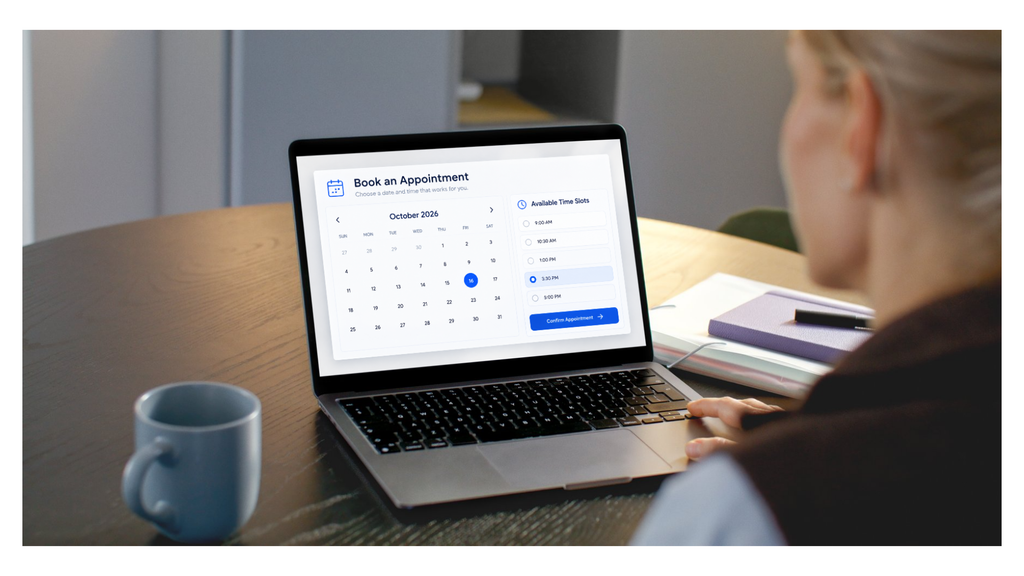
Few tasks waste more time than the exchange of messages needed to agree on a meeting. A shared booking link lets people choose a slot that already suits your calendar. With online appointment scheduling, the back-and-forth disappears, and your calendar stays within the hours you set.
9. Say no to work that does not fit
Every yes spends time you cannot get back. Review your current projects and customers and identify the ones that take the most effort for the least return. Politely decline new requests that sit outside your core offer, and consider raising your prices or ending arrangements that no longer make sense. Saying no is a time management skill, not a failure of ambition.
If you are unsure whether to take something on, ask four questions. Does it fit my core offer? Can it pay what the time is worth? Does it lead to better work or better clients? Can I do it without dropping something more important? If the answer to two or more is no, decline. A courteous reply that thanks the person and explains that it is not the right fit usually leaves the relationship intact.
Part 4: Build Systems That Work While You Do Not
The final group of tips is about reducing the amount of work that needs your direct attention at all. Time management for solo entrepreneurs improves fastest when repeat tasks run on a system.
10. Automate repeat communication
If you send the same welcome message, follow-up, or reminder more than a few times, it should not be written from scratch each time. Set up a short sequence with email marketing so new subscribers and customers receive the right message at the right time without you typing it. Write each message once, review it every few months, and let it do its work.
The best candidates for automation are the messages you already send repeatedly: a welcome email for new subscribers, a reminder before an appointment, a follow-up after a quote, and a thank-you after a purchase. Start with one sequence, check that it reads naturally, and add more as you go. The aim is not to remove the personal touch. It is to make sure nobody waits for a reply while you are busy with other work.
11. Replace scattered tools with one platform
Every extra tool adds logins, subscriptions, and manual handoffs. A common pattern among solo founders is one app for the website, another for forms, another for follow-ups, and another for invoices, with hours lost moving information between them. Consolidating reduces that overhead. Vonza brings your website, forms, CRM, email marketing, invoicing, and sales funnels into one place, so a new lead can be captured, followed up, and paid without leaving the system.
Common Mistakes Solo Entrepreneurs Make with Their Time
Even well-organized founders fall into a few predictable traps. Knowing them in advance makes them easier to avoid.
- Planning an unrealistic day: A schedule packed from morning to evening leaves no room for the unexpected, so one overrun derails everything. Plan for about two-thirds of your available hours and treat the rest as buffer.
- Confusing availability with productivity: Replying instantly to every message feels responsible, but it breaks your focus and teaches clients to expect an immediate answer to everything.
- Neglecting revenue work because it feels uncomfortable: Outreach and follow-ups are easy to postpone in favor of tidying a website or reorganizing files. Put revenue work on the calendar first and let admin fill the gaps.
- Adding tools without a plan: A new app can feel like progress, but every extra one needs setting up, learning, and maintaining. Before adding anything, ask which task it replaces and how much time it will actually save.
Review, Adjust and Keep Going
No set of habits works perfectly from the first week. If you are unsure where your time goes, track it for seven days by noting what you do in half-hour chunks. Most people are surprised by how much time disappears into small tasks and switching between them.
Then make one change at a time. Pick the tip that addresses your biggest drain, apply it for two weeks, and notice the difference before adding another. Changing everything at once rarely lasts. A monthly review of what worked, what did not, and what you will change next keeps the system improving without becoming another source of work.
Also remember that rest is part of the plan. A founder who works without breaks tends to make slower decisions and more mistakes. Schedule time away from the screen as deliberately as you schedule client calls.

Make Time Management for Solo Entrepreneurs a Habit
Good time management for solo entrepreneurs does not require a perfect routine or a long list of apps. It requires a clear view of what matters, a few boundaries you keep, and systems that handle repeat work for you. Start with one tip from each area, give it a few weeks, and build from there.
If you want a single place to run your website, forms, follow-ups, scheduling, and invoices, get started on Vonza and give your week back to the work that grows your business.