Building a personal brand online can open doors to new clients, partnerships, and business opportunities. But somewhere along the way, many professionals started feeling that building a business meant becoming a content creator first.
Post every day. Follow the trends. Record another video. Keep your audience engaged. Repeat.
For consultants, educators, coaches, and other professionals, this can become a job in itself. Instead of spending more time improving their services or working with clients, they find themselves planning posts, editing videos, and checking whether the latest content performed well.
This is what makes personal brand fatigue such a frustrating problem. You may have valuable knowledge and a service people need, yet feel pressured to stay visible online just to keep business coming in.
But there is another way to grow.
You can use social media to help people discover your business without depending on it for every sale. By turning your knowledge into online courses, digital products, coaching programs, and memberships, you can build a business that earns from what you know, not just from how often you post.
The goal is not to disappear from social media. It is to make sure your business has something valuable to offer people after they scroll past your content.
1. The Hidden Cost of Personal Brand Fatigue
Social media can be useful for building awareness, but keeping up with it takes time. There is always another trend, another format to try, or another reason to post.
For someone running a business, those hours have to come from somewhere.
A consultant who spends the morning creating LinkedIn posts has less time for client work. A tutor who spends hours recording short videos has less time to develop learning materials. A coach who is constantly responding to comments may struggle to improve the program they are selling.
The problem is not content creation itself. It is when content creation starts taking priority over the business it is supposed to support.
Consider the difference between these two approaches:
| Building a business | Chasing social media performance |
|---|---|
| Improving products and services | Constantly creating new posts |
| Helping customers get better results | Watching likes, views, and follower counts |
| Building relationships with customers | Trying to reach more people every day |
| Planning around business goals | Changing direction to follow trends |
| Earning through products and services | Depending heavily on social media attention |
When your attention is tied to how well each post performs, it becomes easy to confuse visibility with progress.
A post can receive thousands of views without generating a single sale. Another post may reach only a small audience but bring in a customer who genuinely needs your service.
That is why business owners need to look beyond engagement. What matters is whether their marketing attracts the right people, whether their offers solve a real problem, and whether customers are willing to pay for the value they receive.
Your expertise is the reason people should choose your business. Social media should help them find it, not become the main product you spend your time creating.
2. Breaking the Cycle of Creator Burnout

One of the biggest challenges with relying on social media for business is that you do not control how your content is distributed.
A post that performs well today may receive very little attention next week. A platform may change its recommendation system, your audience may move to another channel, or your account may experience restrictions.
When most of your leads come from social media, these changes can affect your business directly.
The pressure often develops in four stages.
Stage 1: You start sharing what you know.
You publish useful advice, answer questions, and share your experience. People begin following you, and some may become interested in your services.
Stage 2: You notice what gets attention.
Certain posts attract more views than others. You begin creating more of that content, even when it takes you away from the topics you would rather teach or discuss.
Stage 3: Maintaining your image becomes another responsibility.
You feel pressure to keep showing up, appear successful, and make every post interesting. Sharing your knowledge starts to feel like performing for an audience.
Stage 4: Taking a break feels risky.
You worry that fewer posts will mean fewer views, fewer enquiries, and fewer sales. Even when you need time to work on your business, stopping feels like losing momentum.
This is how personal brand fatigue can turn into a business problem.
It can lead to four practical challenges:
- Less time for the work that matters. Marketing begins to compete with client delivery, product development, and customer support.
- Pressure to produce content constantly. You spend more time keeping your accounts active than improving what you sell.
- Difficulty standing out. You feel pushed to copy popular formats instead of explaining what makes your approach useful.
- Sales that depend too heavily on visibility. People may engage with your content without having a clear way to buy from you.
The solution is not necessarily to post less and hope for the best. It is to give your business other ways to attract customers, build relationships, and generate sales.
3. Rented Reach vs. Digital Assets You Control
Think about what happens when someone follows your business on Instagram, TikTok, or LinkedIn. You can see that person in your audience, but you cannot assume they will see every post you publish.
Your access to that audience depends partly on the platform.
Now consider someone who visits your website, signs up for your newsletter, buys your course, or joins your paid membership. You have a more direct relationship with that person and a clearer way to continue serving them.
That difference matters when you want to build a business for the long term.
| Social media channels | Your business assets |
|---|---|
| Followers and post engagement | A permission-based email list |
| Short-lived posts and videos | A website and useful resource library |
| Reach that can change unexpectedly | Direct communication with customers |
| Links that send people elsewhere | A clear path from discovery to purchase |
| Attention that may never lead to a sale | Courses, products, services, and memberships |
Your website, customer records, product library, and email list give you more control over how you serve your audience. They also give people a place to return to when they are ready to buy.
This does not mean that social media has no value. It remains a useful way to introduce your business to people who may never have discovered it otherwise.
The important thing is to give interested people a next step.
For example, a consultant could share a LinkedIn post about a common problem businesses face and direct readers to a free checklist on their website. Someone who downloads the checklist could choose to receive further advice by email and later learn about a paid consulting service.
The social post attracts attention. The website captures interest. The email list helps build the relationship. The paid offer gives the customer a way to work with the business.
Instead of starting from scratch every time you publish something, you create a path that can continue working after the post has disappeared from the feed.
4. Monetizing Your Expertise Without Becoming a Full-Time Influencer
You do not need a huge following to start selling something useful. What you need is a clear understanding of the people you want to help, the problems they face, and the knowledge or skills you can offer them.
A smaller audience of people who genuinely need your expertise can be more useful to your business than a much larger audience with little interest in buying.
Here are three examples of how professionals can turn what they already know into products people can pay for.
Educational specialists
Tutors, teachers, and corporate trainers can turn their teaching experience into structured online courses, revision guides, lesson resources, and downloadable worksheets.
Rather than explaining the same topic from scratch in every session, they can create learning materials that students access whenever they need them.
Live lessons and individual support can remain part of the business, while the course or resource provides another way to earn from their knowledge.
Design and technical consultants
Designers, developers, and other technical professionals often solve similar problems for different clients.
They can turn parts of that experience into website templates, design resources, practical guides, code libraries, or recorded workshops.
These products will not replace every consulting project, but they can give customers a more affordable way to learn from the professional’s experience.
Operations and management experts
Professionals who understand business processes, team management, and workflow improvement can package their knowledge into SOP templates, onboarding guides, project management resources, and group coaching programs.
A business owner who needs help organising a team, for example, may be willing to pay for a ready-to-use operations toolkit instead of starting with a blank document.
In each case, the opportunity comes from identifying something people already need and making it easier for them to access that knowledge.
The same expertise that helps you deliver a service can often be used in more than one format. You can continue working directly with clients while building products that reach people who cannot afford, or do not need, your full service.
5. Turning Social Media Attention into Revenue-Generating Products
Once you have identified what people need from you, the next step is deciding how to package it.
You do not have to launch several products at once. Start with the format that makes the most sense for your knowledge, your customers, and the time you have available.
1. Online courses
An online course allows you to organise your knowledge into lessons people can follow at their own pace.
You might teach a professional skill, explain how to use a particular tool, or guide learners through a process you have already helped clients complete.
Once the course is ready, you can continue improving it and selling access without personally delivering every lesson. You will still need to answer questions, update material, and support learners where necessary, but the teaching itself does not have to start from zero with every new customer.
2. Individual and group coaching
Some customers want more than a recorded lesson. They want feedback, guidance, and help applying what they have learned.
You can offer individual coaching for customers who need personalised support or group programs for people working towards similar goals.
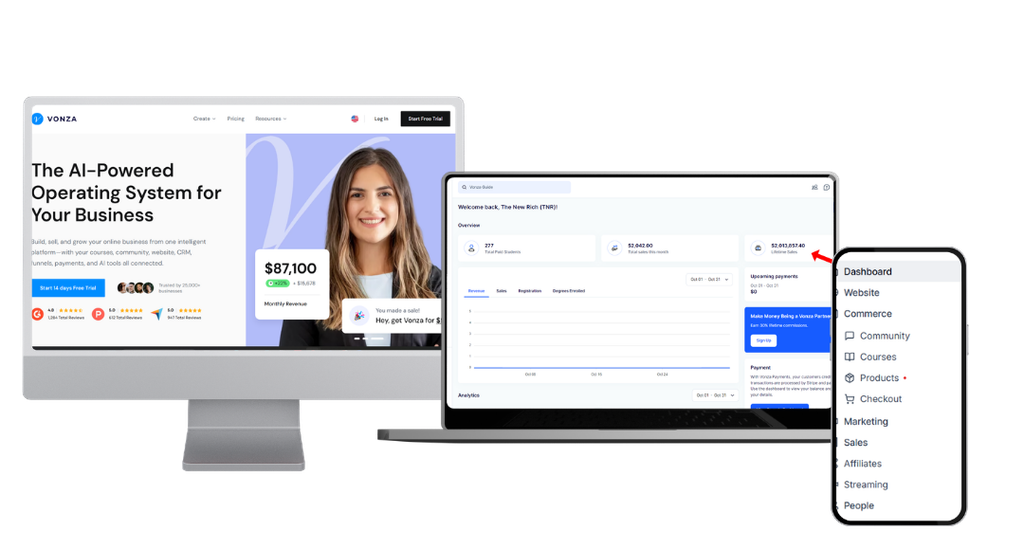
A dedicated online space like Vonza can help you organise sessions, share learning materials, communicate with participants, and keep the program running smoothly.
3. Paid memberships and communities
A membership works well when customers have a reason to keep coming back.
That might mean monthly training sessions, new resources, expert discussions, peer support, or access to a professional community.
Unlike a one-time purchase, a membership can generate recurring revenue while it continues to provide value. The important part is giving members a clear reason to stay rather than simply charging them for access.
4. Digital downloads
E-books, templates, workbooks, checklists, and other downloadable resources can be a practical starting point.
Suppose people regularly ask you for a project plan, a customer service script, or a spreadsheet template. You could turn that resource into a paid product that helps customers solve the problem themselves.
Digital downloads can also introduce new customers to your work before they decide to invest in a course or a more personalised service.
The next challenge is managing all these offers without creating another complicated workload.
When your website, course hosting, email marketing, customer records, and payments are spread across different tools, running the business can become almost as demanding as promoting it.
This is where an all-in-one platform such as Vonza can help. Instead of managing separate systems for every part of your business, you can bring key activities together in one place, depending on the features included in your plan.
The idea is simple: spend less time moving between tools and more time creating products, supporting customers, and improving your business.
6. Four Steps to Stop Chasing Algorithms and Start Building Your Business
You do not need to abandon your social media accounts or rebuild your entire business overnight. Start by making a few practical changes to how you attract and serve customers.
Step 1: Give every channel a clear purpose
Decide what you want each platform to do for your business.
Perhaps LinkedIn helps you reach potential consulting clients, Instagram introduces people to your teaching, and your website gives visitors more information about your offers.
You do not have to publish everything everywhere. Choose the channels that make sense for your audience and use them to guide interested people towards a useful next step.
Step 2: Create one product from knowledge you already have
Look at the questions customers ask repeatedly. What do people need help understanding? Which tasks do you explain again and again? What process have you developed that others could learn from?
Choose one problem and create a practical resource to address it.
It could be a short course, a downloadable guide, a workshop, or a set of templates. You can start small, see whether people find it useful, and improve it based on their feedback.
Step 3: Build a direct relationship with your audience
Give people a reason to connect with you outside social media.
For example, offer a free checklist, a useful guide, or a short training session in exchange for signing up to your email list. Make it clear what subscribers will receive, and send them relevant information rather than constant sales messages.
With their permission, you can use email to share new resources, answer common questions, announce offers, and invite subscribers to explore your paid products.
Your email list will not guarantee sales, but it gives you another way to maintain relationships without relying entirely on social media reach.
Step 4: Measure business results, not just likes
Keep track of the numbers that help you understand whether your business is growing.
Start with these four:
- Website conversion rate: How many visitors take the action you want, such as signing up or making a purchase?
- Customer acquisition cost: How much are you spending to attract each new customer?
- Course completion rate: Are learners making their way through your course?
- Repeat purchases and membership retention: Are customers returning or continuing to pay for your offers?
You can still monitor views, comments, and follower growth. Just do not let them become the only measures of success.
A post that brings ten relevant visitors to your website may be more valuable than one that attracts thousands of views without generating interest in your products.
Over time, these measures can help you decide where to invest your effort and which offers deserve more attention.
7. Define Success on Your Own Terms
Building a personal brand can be rewarding, but it should not require you to be available to an online audience every day.
You can share useful ideas, connect with potential customers, and maintain a visible presence without making constant content production the centre of your working life.
A more sustainable business gives you room to improve your services, develop new products, build customer relationships, and take time away from social media when necessary.
It also gives customers more than one way to work with you. Someone might discover you through a social post, subscribe to your newsletter, buy a digital guide, and later enrol in your course or join your coaching program.
That relationship has the potential to become much more valuable than a single interaction with a post.
The aim is not to eliminate marketing. Every business needs a way to reach people. The aim is to build a business where marketing supports the work you do instead of taking over your day.
You do not need to become a full-time influencer to earn from your expertise. Start with what you know, create something that helps people, and build a reliable way for them to find and buy it.
Build Your Business Beyond Social Media
If you are ready to turn your knowledge into something you can sell online, you need more than a place to publish content. You need a way to present your offers, deliver your products, communicate with customers, and manage the business behind them.
Explore Vonza to see how its all-in-one platform can help you bring online courses, digital products, coaching, and memberships together.
Keep using social media to reach new people. Just make sure you are building a business they can return to long after they have scrolled past your latest post.