
Running a business used to require a headcount.
Decades ago, launching even a modest service or digital business venture meant recruiting specialists or dividing yourself across half a dozen distinct operational roles. You needed someone for marketing, someone to answer customer support tickets, a person to manage sales pipelines, an administrator to handle scheduling, a finance specialist for payment processing, and a web developer to ensure digital products actually delivered to buyers.
For most people, entrepreneurship was limited by how much one person could realistically handle and coordinate.
Today, that math is changing. A new wave of independent creators, coaches, consultants, and freelancers are building highly profitable one-person businesses without massive teams. They aren’t superhuman, and they aren’t working eighty-hour weeks. Instead, they are using new technology to do more with less and handle tasks that once required an entire team.
A one-person business is often misunderstood. It does not mean a lone individual manually executing every single task from dawn until midnight. That is simply burnout disguised as independence.
Instead, a true one-person business is one where the owner uses technology, automation, and AI to handle more of the business without doing everything manually.
Instead of hiring five people to handle content creation, email newsletters, customer inquiries, and booking coordination, the modern entrepreneur uses integrated digital infrastructure to handle the repetitive machinery of the business.
The business owner brings the expertise, creativity, and human connection. Technology takes care of the repetitive work.
Why AI is Changing How Small Businesses Operate
Artificial intelligence has dominated tech headlines for years, but much of the discourse focuses on flashy, generalized hype. For independent business owners and solo entrepreneurs, the real utility of AI is far more grounded.
AI excels at removing friction from everyday execution. Practical applications include:
- Drafting and refining content: Generating initial outlines for blog posts, email campaigns, or course modules.
- Customer communication support: Suggesting clear, empathetic responses to common client questions.
- Rapid research and synthesis: Summarizing long industry reports or brainstorming curriculum structures.
- Administrative organization: Cleaning up messy spreadsheets and categorizing client feedback.
AI does not replace your entire team or make business strategy effortless. For a one-person business, its real value is in reducing repetitive work and giving the owner more time for strategy, creativity, and customer relationships.
The Problem With Using Too Many Business Tools

As digital entrepreneurship expanded, software companies rushed to solve every niche problem. The result? Creators often build a Frankenstein’s monster of disconnected tools.
A typical tech stack for a growing online business often looks like this:
- A separate website builder for landing pages.
- A standalone course platform for digital products.
- An independent email marketing service for newsletters.
- A third-party CRM for customer notes.
- A distinct scheduling app for consultation calls.
- A payment gateway disconnected from everything else.
But using so many disconnected tools comes with a hidden cost.
More subscriptions mean higher monthly overhead. More logins mean constant context-switching. Most dangerously, data gets scattered across platforms. When a customer buys a course on one tool, books a call on another, and emails support through a third, your customer history shatters. Important details fall through the cracks, leading to delayed responses and frustrated clients.
Why All-In-One Platforms Are Becoming More Important
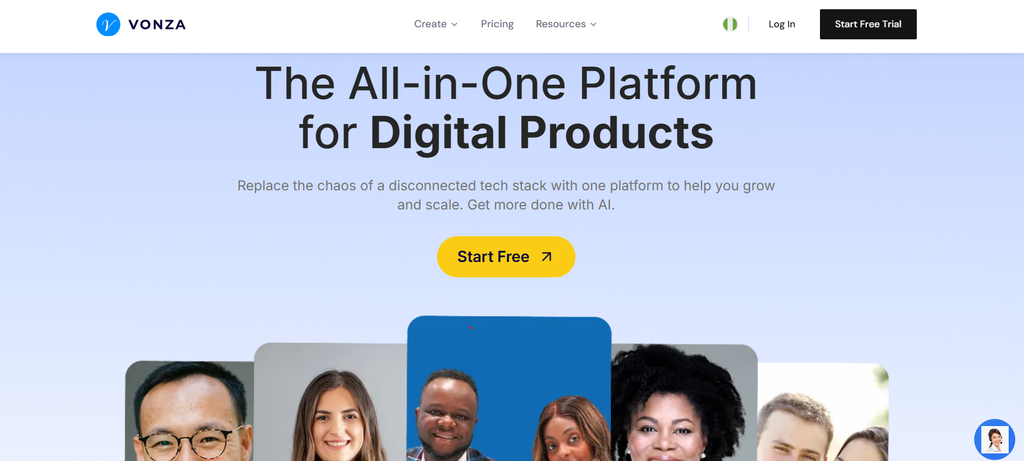
Solving operational fragmentation requires bringing the core pillars of your business under one roof.
When your software systems talk to each other natively, everything changes. Customer management, email marketing, course delivery, digital downloads, scheduling, and payment collection stop operating separately.
This is where Vonza’s all-in-one platform provides a natural home for modern creators. Rather than forcing entrepreneurs to staple together separate apps with a collection of plugins and third-party integrations, a unified environment keeps everything connected.
When your online courses and membership sites live in the same ecosystem as your built-in CRM platform and sales funnels and checkout pages, you reduce the extra work that comes with managing a digital business across multiple platforms. You stop being a software integration technician and go back to being an expert creator.
AI + Automation + One Platform: The New Business Stack
To see why this works so well, it helps to look at how three things work together:
- AI → Helps you create, draft, and make decisions faster.
- Automation → Helps repetitive processes happen without manual intervention.
- All-in-one platforms → Keep your entire business operation connected in one place.
When you combine all three, you create a much more efficient way to run your online business.
AI writes your initial email sequence. Automation drops those emails into your automated email marketing sequences based on customer behavior. And your all-in-one platform tracks whether that customer opened the email, bought your product, and booked a call using your scheduling tools for consultation calls—all without having to manage each step manually.
What a Lean Online Business Could Look Like
Imagine a solo entrepreneur, business consultant, or online educator launching a new program.
- Attraction: They publish educational content that draws interested prospects to their landing page.
- Conversion: Visitors review the offering through clean sales funnels and checkout pages and complete their purchase securely.
- Fulfillment: The platform instantly processes payment, issues login credentials, and drops the buyer into their online courses and membership sites.
- Support & Retention: Client details flow directly into your built-in CRM platform, allowing you to track progress, send automated check-ins via automated email marketing sequences, and invite them to book follow-ups using scheduling tools for consultation calls.
Every stage works together instead of requiring the founder to manage each system separately. The founder didn’t need an IT department to stitch it together.
What Technology Can’t Replace
Even with advanced AI and connected platforms, there are still things technology can’t do.
Software can’t create genuine trust between a business and its customers. It cannot feel empathy when a client is frustrated, nor can it replace real expertise, good judgment, or the personality that makes a brand feel human.
The goal of modern automation is never to distance yourself from your audience. The real goal is to reduce the repetitive administrative work so you can spend more of your time and energy on the things that genuinely require a human touch: coaching, creative breakthroughs, and meaningful relationships with your clients.
Is the One-Person Business the Future?
Technology has made it easier than ever to start and run a business, making the one-person business model increasingly accessible to entrepreneurs around the world. Anyone with expertise, a computer, and an internet connection can package their knowledge and reach a global market.
However, tools alone do not guarantee success. But technology doesn’t change the basics of running a successful business. You still need a valuable offer, a clear understanding of your audience’s problems, consistent execution, and unwavering integrity.
When you pair a great offer with the right technology, running a lean business stops being an exhausting juggling act and becomes a more manageable and sustainable way to grow.
Ready to see how a unified platform can streamline your workflow? Explore Vonza to manage your courses, marketing, CRM, and customer operations in one place.